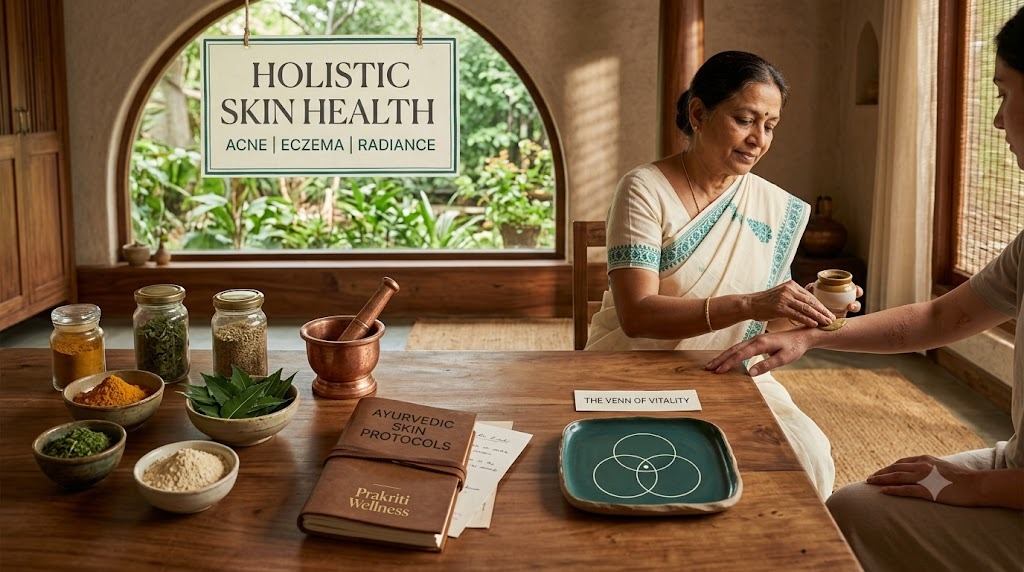



Most people who live with chronic acne or eczema know this feeling well. You try a new cream. It helps for a few weeks. Then the breakout returns, or the patch of eczema spreads somewhere new, or your skin simply goes back to doing exactly what it was doing before. The product changes. The problem stays.
This is not a failure of effort. It is a limitation of approach. Conventional skincare, for all its advances, largely addresses the surface — the redness, the dryness, the inflammation, the breakout. What it rarely addresses is the internal environment that produced those symptoms in the first place. And in Ayurveda, that internal environment is where the conversation about skin health actually begins.
The skin does not lie. It reflects the state of everything happening beneath it.
How Ayurveda Understands Skin Conditions
In Ayurvedic medicine, the skin is not treated in isolation. It is seen as an external expression of the body's internal balance, particularly the quality of the blood, the health of the digestive system, and the state of the liver.
When the digestive fire, Agni, is weak or imbalanced, food is not fully processed. This leads to the accumulation of Ama, the Ayurvedic term for undigested toxins. These toxins circulate through the blood and eventually find their way to the surface of the skin. Chronic skin conditions — persistent acne, recurring eczema flares, skin that never quite settles — are often understood in Ayurveda as the skin pushing out what the body has not been able to eliminate through its usual channels.
This is why two people can eat the same food, use the same products, and have completely different skin outcomes. The difference is not the surface. The difference is what is happening inside.
Doshas and Skin: Understanding Your Skin's Constitution
Each of the three doshas has a distinct relationship with the skin, and chronic skin conditions almost always have a dominant doshic pattern behind them.
Pitta & Acne
Aggravated Pitta generates excess heat that surfaces through the skin. Pitta acne is red, inflamed, and painful — triggered by spicy food, alcohol, sun exposure, and stress.
Vata & Eczema
Vata imbalance makes skin dry, rough, and prone to cracking. Eczema worsens in cold weather, under stress, and with irregular eating — the itch often peaks at night.
Kapha & Congestion
Excess Kapha makes skin oily, congested, and prone to cysts or closed comedones. Slower to shift, but responsive to lighter food and circulation-boosting therapies.
What Ayurvedic Treatment for Skin Actually Looks Like
- Digestive correction. Strengthening Agni and clearing Ama from the gut, which reduces the toxic load reaching the skin.
- Blood purification. Herbs like Neem, Manjistha, and Guduchi cleanse the blood and reduce inflammatory activity.
- Dietary adjustment. Identifying and removing the foods aggravating your dominant dosha.
- External herbal therapy. Targeted herbal applications that support healing without disrupting the skin's natural barrier.
- Stress and nervous system care. Addressing the Vata component that drives both anxiety-related flares and poor sleep quality.
The Dietary Connection Most People Underestimate
In Ayurveda, what you eat either feeds your skin or aggravates it. This is not an abstract idea — it is one of the most clinically observed patterns in Ayurvedic practice.
For Pitta-dominant skin, the priority is reducing heat: spicy food, fermented foods, excess caffeine, alcohol, and excessively salty or sour foods all worsen inflammation. Cooling foods like cucumber, coconut, coriander, and sweet juicy fruits often produce visible improvement within a few weeks of consistent change.
For Vata-dominant skin, the issue is usually irregular eating, insufficient healthy fats, and food that is too dry or cold. Warm, oily, nourishing meals at regular intervals are deeply stabilising. Ghee, in particular, lubricates from the inside in a way no topical moisturiser can replicate.
For Kapha-dominant skin, reducing heavy, sweet, and processed foods makes a meaningful difference. Light, warm, well-spiced food that stimulates digestion and circulation is the direction to move in.
Clear skin in Ayurveda is not something you apply. It is something you build, from the inside, one meal and one day at a time.
The Herbs Ayurveda Has Used for Skin for Centuries
- Neem — antibacterial, antifungal, and deeply purifying. Reduces bacterial activity and cools Pitta inflammation for acne; helps manage secondary infection from persistent scratching in eczema.
- Manjistha — one of Ayurveda's primary blood purifiers, particularly effective for chronic, stubborn skin conditions rooted in accumulated toxins.
- Turmeric — taken internally, it reduces systemic inflammation, supports liver function, and helps the body process Pitta more effectively.
- Guduchi — supports immunity and has a cooling, purifying effect on the blood, valued for skin conditions with an autoimmune component.
- Aloe Vera — cools Pitta and soothes inflamed skin. Fresh aloe vera juice on an empty stomach each morning is a simple, effective addition for heat-pattern acne.
Panchakarma for Chronic Skin Conditions
For skin conditions that have been present for years and have not responded adequately to other approaches, Panchakarma offers something genuinely different. These classical therapies work at the level of the tissues and the blood, addressing accumulated Ama and Pitta at a depth dietary changes and herbal medicines alone sometimes cannot fully reach.
Virechana, medicated purgation therapy, is one of the most specific treatments for chronic Pitta-related skin conditions — directly cleansing the liver and blood of accumulated heat. Raktamokshana, blood purification therapy, works at the level of the blood directly and is one of the oldest therapeutic approaches in Ayurvedic dermatology. These require the guidance of an experienced Ayurvedic physician at a properly staffed, verified retreat.
What a Realistic Treatment Timeline Looks Like
Ayurvedic treatment for chronic skin conditions works, but it works at the pace of the body, not the pace of a topical product. Dietary changes and herbal support can produce visible improvement within four to eight weeks for many people. The deeper work of gut healing, blood purification, and Panchakarma takes longer, and the results tend to be more lasting.
WEEK 1–2
Dietary changes begin. Digestive symptoms often improve first. Skin may initially purge before clearing.
WEEK 3–6
Reduction in new breakouts or flare frequency. Skin texture begins to improve.
MONTH 2–3
Sustained improvement in skin clarity, reduced inflammation, better gut health.
MONTH 3–6
With Panchakarma and consistent lifestyle changes, deeper and more lasting transformation becomes evident.
The purging phase in the first two weeks is worth mentioning specifically. When the body begins eliminating accumulated toxins, the skin sometimes worsens briefly before it improves. This is a well-documented pattern in Ayurvedic practice — a sign the process is working, not a reason to stop.
What Makes the Ayurvedic Approach Genuinely Different
Most approaches to chronic skin conditions treat the skin as the source of the problem. Ayurveda treats the skin as a messenger. The acne, the eczema, the persistent dryness or congestion — these are messages from the gut, the liver, the blood, and the nervous system. Address what is sending those messages, and the skin changes.
This is not a promise that Ayurveda will clear your skin overnight. It is a deeper offer than that — the possibility of understanding why your skin has been behaving the way it has, and addressing that reason at its actual source.
Lasting skin health is not the absence of breakouts. It is the presence of balance.